
EMDR Intensive vs. Weekly EMDR: Which Is Right for You?

"Should I come every week, or should I try an intensive?"
It's a fair question, and there is no single right answer. I'm Tess Prince Harris, a Licensed Professional Counselor trained in EMDR, and I offer both. When people ask me about an EMDR intensive vs. weekly EMDR, I tell them the same thing: the method is the same. What changes is the pace, the time, and how it fits your life.
This post lays out the real differences, what the research says, and a few honest signs that point one way or the other.
The Short Answer
Weekly EMDR is a 50-minute session on a steady schedule. It builds safety and trust a little at a time. An EMDR intensive is a longer session, 90 minutes with me, that gives you more room to stay with one memory and close with care. The best choice depends on your schedule, your goals, and how steady life feels.
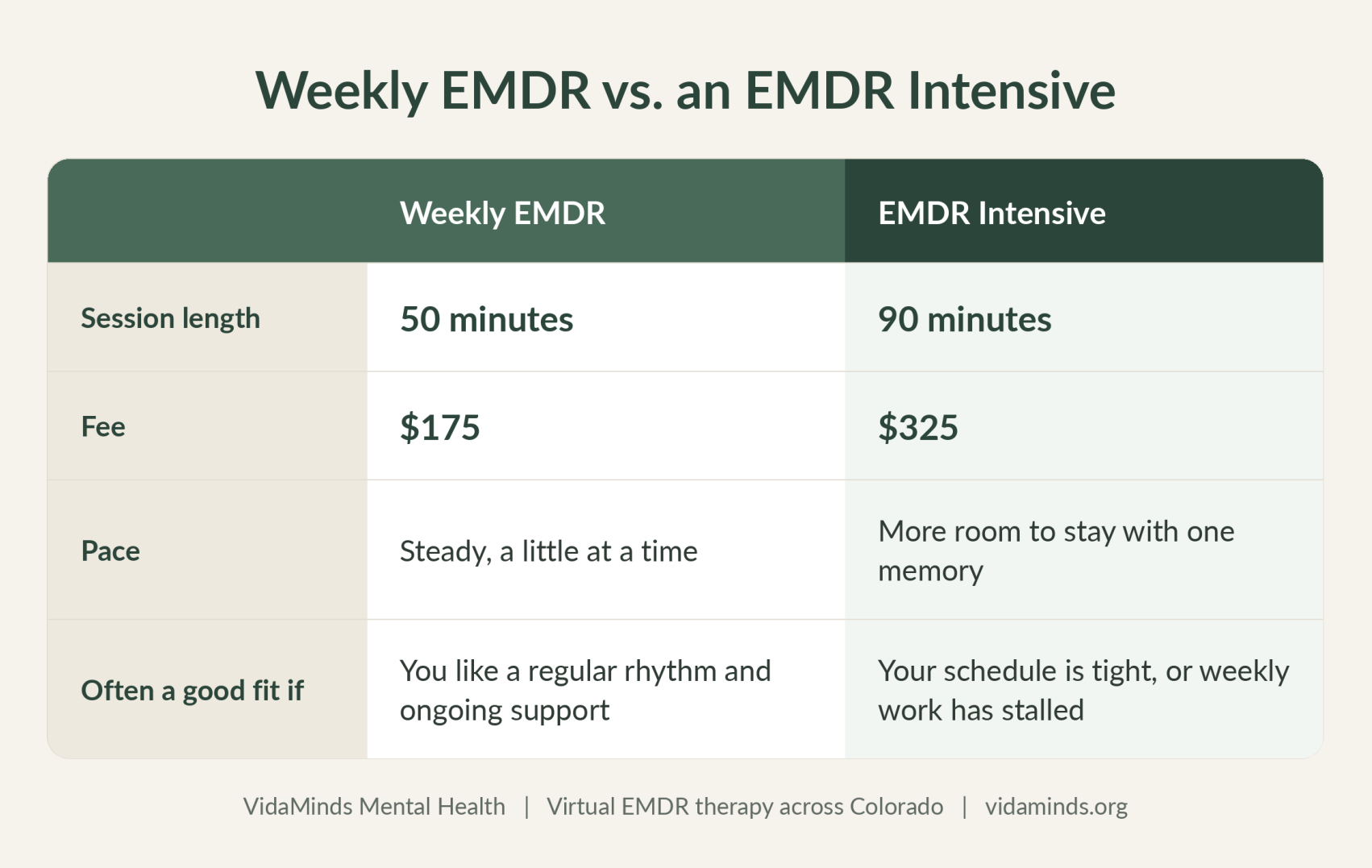
EMDR Intensive vs. Weekly EMDR at a Glance
**A quick note on cost. Minute for minute, the two are priced about the same. The real difference is how the time is used, not what it costs.
What Does the Research Say?
I want to be honest with you here, because "intensive" gets used in a lot of ways.
Most studies on intensive trauma therapy look at many sessions packed close together, not one longer session. Still, what they found is encouraging:
Intensive EMDR worked as well as weekly EMDR. One study compared 30 veterans with PTSD. Half had EMDR once a week. Half had it twice a day for 10 days. Both groups improved a great deal, and the gains held a year later (Hurley, Frontiers in Psychology, 2018).
People tend to finish intensive treatment. A review of 11 studies of intensive PTSD treatment found that only about 5.5% of people dropped out (Sciarrino, Warnecke, & Teng, Journal of Traumatic Stress, 2020). That review looked at other trauma therapies, not EMDR. For comparison, a large review of PTSD therapy trials found that about 16% of people stopped early (Lewis and colleagues, European Journal of Psychotraumatology, 2020).
90-minute EMDR sessions have been studied for decades. In an early trial of 80 people, three 90-minute EMDR sessions eased distress tied to painful memories, and the results held 90 days later (Wilson, Becker, & Tinker, Journal of Consulting and Clinical Psychology, 1995).
No study can promise how your healing will go. What the research does tell us is that longer and more focused EMDR sessions are a sound, well-studied way to work.
How to Choose

Weekly EMDR may fit you better if:
You are new to therapy, or new to EMDR
Life feels unsteady right now, or you are in a crisis
You want time to build coping tools before going deeper
You are working through many experiences over many years
You like knowing you have support every week
An EMDR intensive may fit you better if:
You have one memory that keeps coming back, such as a call, an accident, a loss, or a birth that did not go as planned
Weekly therapy helped, but you have hit a plateau
Shift work or a full house makes a weekly slot hard to keep, which many of the first responders I work with know well
You already have grounding skills and feel ready to go deeper
Starting with weekly sessions is not a step back. It is honoring your pace.

Questions I Hear a Lot
-
Not more effective, based on what we know so far. In the study above, both formats led to strong results that lasted. The difference is pace and fit.
-
Yes. This is not a forever choice. We can look at your plan together as we go and change it if your needs change.
-
You might feel tired, the way you do after a long hike. I suggest keeping the rest of your day light. A walk, some water, and an early night can help.
-
No. EMDR does not ask you to describe everything out loud, in either format. You share what feels right to you.
Learn more about EMDR & EMDR Intensive with Tess Prince Harris, LPC
*This post is for education only and is not a substitute for therapy. If you are in crisis, call or text 988 to reach the 988 Suicide & Crisis Lifeline.